Why Standard 'Clinical Decision Support' Is Failing (And Why Chat-Based AI Is The Future)
If you have to click through 12 menus to find a renal dosing adjustment, that isn't "support." That’s an obstacle.
For the last 20 years, Clinical Decision Support Systems (CDSS) have looked the same: massive, expensive databases that require a desktop computer and five minutes of silence to navigate.
In 2025, the workflow of an independent pharmacist has changed. You are vaccinating, prescribing (Test-and-Treat), and managing inventory simultaneously. You don't have time to navigate a "library." You need an answer.
This demand for speed is driving the massive shift toward Chat-Based AI. But as clinicians rush to tools like ChatGPT, a new danger has emerged: The Hallucination.
Here is why the future of pharmacy isn't "Big Data"—it's "Verified Chat."
What is a Modern Clinical Decision Support System?
A Modern CDSS is an AI-driven tool that allows clinicians to ask complex patient-specific questions in natural language and receive immediate, evidence-based answers with direct citations to the primary source.
Unlike legacy systems (which are essentially digital encyclopedias), modern tools like Rx Agent act as a research assistant. They don't just "know" facts; they look them up, verify them, and summarize them for your specific patient scenario.
The Problem: "Click Fatigue" vs. "The Wild West"
Right now, pharmacists are stuck between two bad options:
Option A: The Legacy Giants (UpToDate, Lexicomp, Micromedex)
- Pros: Highly accurate, trusted.
- Cons: Incredibly expensive ($$$), slow to navigate, and built for sitting at a desk—not standing at a counter.
- The User Experience: Open app -> Login -> Search Drug -> Click Dosing -> Click Renal -> Read paragraph -> Calculate.
It's no wonder pharmacists are actively searching for alternatives to Lexicomp and alternatives to UpToDate—the subscription costs and clunky interfaces don't match modern pharmacy workflows.
Option B: The General AI (ChatGPT, Gemini)
- Pros: Fast, conversational, free.
- Cons: It lies. General LLMs are trained to "sound" correct, not to be correct. They frequently invent citations, make up drug interactions, or misinterpret black box warnings.
- The User Experience: Ask question -> Get answer -> Pray it isn't made up.
The "Experience" Gap: Why I Built a Third Option
I spent years working with pharmacy technology, and I noticed a terrifying trend. Pharmacists were secretly using ChatGPT to check interactions because their "official" software was too slow.
I realized we didn't need more data. We needed a safer way to access it.
We built Rx Agent to sit exactly in the middle:
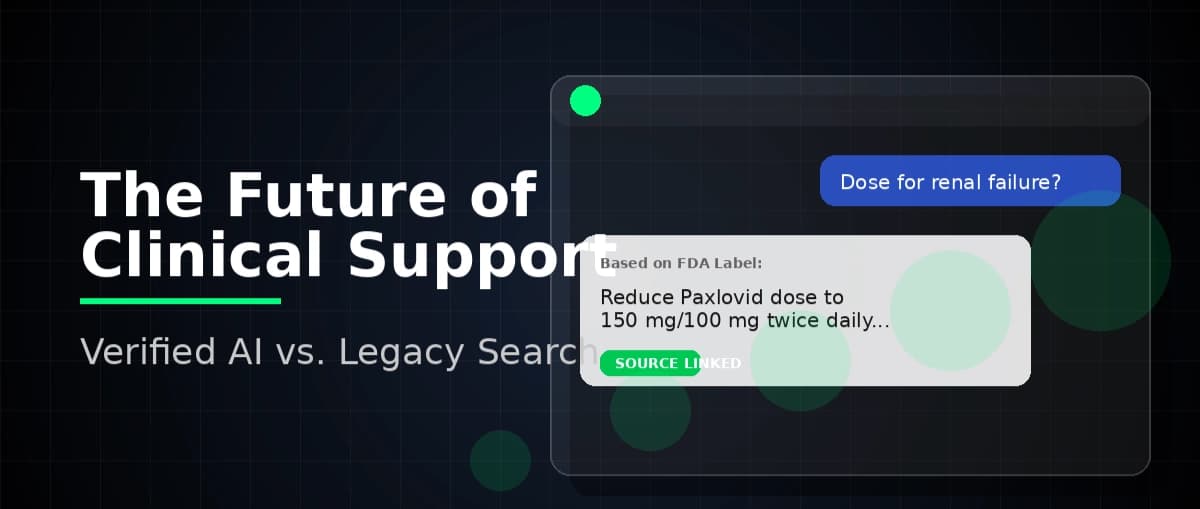
- The Interface of ChatGPT: You just type, "Can I give Paxlovid to a patient on Amiodarone?"
- The Brain of a Pharmacist: It doesn't generate an answer from memory. It searches the FDA package insert, finds the interaction section, and summarizes it.
- The Proof: It highlights the exact text in the source document so you can verify it instantly.
3 Reasons Independent Pharmacies Are Switching to Chat-Based CDSS
1. Speed is Safety
When a line of 10 patients is staring at you, you are less likely to check a mild interaction if it takes 5 minutes. If it takes 5 seconds, you check it every time. Friction causes errors. By removing the friction of "searching," we increase the frequency of safety checks.
2. "State-Specific" Intelligence
Legacy CDSS tools are national. They know the FDA label, but they don't know that California SB 493 changed your prescribing authority last week.
Because Rx Agent connects to live legal databases, it can answer:
"What is the protocol for dispensing Naloxone in Ohio?"
Try asking a textbook that question.
3. Cost-Effective Scalability
Hospital systems pay millions for enterprise licenses. Independent pharmacies operate on thin margins (especially with PBM clawbacks). AI-driven tools can deliver the same level of clinical insight at a fraction of the cost because they don't require armies of manual data-entry teams—they use retrieval technology to read existing medical literature.
The "Hallucination" Test: How to Spot Dangerous AI
If you are using an AI tool in your pharmacy, put it to the test today.
Ask it for a citation.
- Bad AI: Will generate a title like "Smith et al., Journal of Pharmacy, 2023" that doesn't exist.
- Good AI (CDSS): Will provide a clickable link to a PDF hosted on
fda.govornabp.pharmacy.
If you can't click the source, do not trust the answer.
Summary: The Future is Verified
The era of memorizing facts is over. The era of retrieving facts instantly is here.
As pharmacists, our value isn't being a "walking encyclopedia." It's making judgment calls based on the best available data. You deserve a tool that respects your time and protects your license.
Ready to upgrade your Clinical Decision Support? Try 1 Free Search and stop fighting with clunky software.
Frequently Asked Questions
About the Author
Zade Shammout, PharmD writes about prescription medications, pharmacy laws, and healthcare compliance for prescribers and pharmacists.