
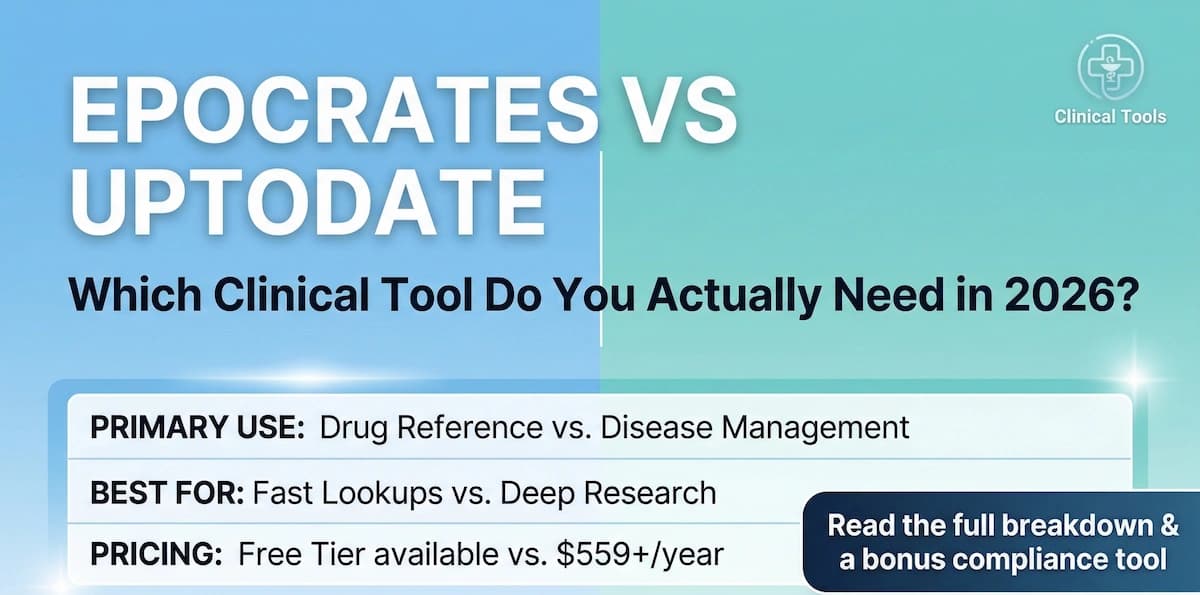
Epocrates vs UpToDate: Which Clinical Tool Do You Actually Need in 2026?
Disclaimer: This comparison is based on publicly available product information and our team's clinical experience. Features and pricing may change. Always verify current details with each vendor.
Epocrates vs UpToDate: Why This Comparison Matters
If you prescribe medications, you've probably used one or both of these tools — but you may be using the wrong one for the moment.
I've watched residents pull up UpToDate to check a gabapentin dose during rounds. That's a 30-second task that takes two minutes because UpToDate wasn't designed for quick drug lookups. I've also seen attendings try to use Epocrates to understand the evidence behind a treatment decision for newly diagnosed lupus. That's not what Epocrates was built for either.
The Epocrates vs UpToDate question isn't really "which is better" — it's "which tool matches the clinical question in front of you right now?" And as I'll explain, there's a third category of question that neither tool answers at all.
Quick Comparison: Epocrates vs UpToDate
| Feature | Epocrates | UpToDate |
|---|---|---|
| Primary use | Drug reference & prescribing support | Evidence-based clinical decision support |
| Best for | Dosing, interactions, pill ID, formulary | Diagnosis, management plans, treatment evidence |
| Drug database | Core strength — fast, mobile-first | Included via Lexidrug integration |
| Disease content | Limited (Epocrates+ only, via BMJ) | Extensive — 12,000+ topics by 7,400+ authors |
| Evidence citations | No | Yes — GRADE-rated evidence |
| Drug interaction checker | Yes — up to 30 drugs at once | No dedicated checker |
| Pill identifier | Yes | No |
| Medical calculators | 600+ | Yes (fewer) |
| Formulary lookup | Yes — 6,600+ U.S. insurance plans | No |
| CME credits | Yes (free tier) | Yes |
| EHR integration | No | Yes |
| Mobile app | Yes — purpose-built | Yes — but desktop-optimized |
| Free tier | Yes | No |
| Pricing | Free / $174.99/year (Plus) | From $559/year |
| State prescribing rules | No | No |
| PDMP / controlled substance tracking | No | No |
When to Use Epocrates
Epocrates wins when speed matters more than depth.
I use Epocrates dozens of times a day for the same handful of tasks: confirming a dose, running a quick interaction check before adding a med, identifying a pill a patient brought in, and checking formulary coverage for a specific insurer. These are 5–15 second lookups, and Epocrates handles them faster than anything else I've tried.
The free tier alone covers drug monographs (prescribing info, safety, dosing, adverse reactions, contraindications, black box warnings), the interaction checker, pill ID, clinical guidelines, formulary data for 6,600+ U.S. insurance plans, and 600+ calculators. That's a remarkable amount of utility at zero cost.
Epocrates+ ($174.99/year) adds disease content developed in collaboration with BMJ, infectious disease treatment guides, alternative medicine monographs, lab references, and ICD-10 codes. It's a solid upgrade for clinicians who want more than just drug lookups — but the disease content still doesn't approach UpToDate's depth.
Best Epocrates moments:
- Mid-appointment dose confirmation
- Pre-prescribing interaction checks
- Patient brings in an unidentified pill
- Verifying insurance formulary coverage
- Quick calculation during rounds
When to Use UpToDate
UpToDate wins when you need to understand the "why" behind a clinical decision.
UpToDate is not a drug reference tool — it's a clinical knowledge base. When I'm working up an unfamiliar presentation, revisiting a guideline I haven't touched in months, or explaining treatment rationale to a patient, UpToDate is where I go. The content is authored by 7,400+ physician specialists, peer-reviewed, and graded using the GRADE evidence framework. It covers over 12,000 clinical topics across virtually every specialty.
The trade-off is speed. UpToDate is optimized for depth and comprehensiveness, not for quick lookups. Finding a specific drug dose inside an UpToDate topic takes longer than it would in Epocrates. And at $559/year for an individual subscription, it's a premium investment — though many clinicians access it through their institution.
UpToDate also includes drug information through its Lexidrug integration, so it technically overlaps with Epocrates on drug content. But the experience is different. Epocrates is like a pocket reference card; UpToDate is like a textbook chapter.
Best UpToDate moments:
- Working up an unfamiliar diagnosis
- Reviewing evidence for a treatment you're unsure about
- Preparing for a clinical discussion or presentation
- Comparing management strategies across guidelines
- Earning CME through routine clinical lookups
The Gap Neither Tool Covers: State Prescribing Rules
Here's what I realized after years of using both: Epocrates tells you how to dose gabapentin. UpToDate tells you why to prescribe it. Neither one tells you whether you legally can.
That sounds dramatic, but it's a daily reality for clinicians prescribing across state lines, managing controlled substances, or working in telehealth. Consider what happened to me in 2024: I wrote a gabapentin refill for a telehealth patient who had moved to Utah. The prescription bounced. Why? Utah had just classified gabapentin as a Schedule V controlled substance, and my prescription didn't meet the new requirements. Neither Epocrates nor UpToDate flagged that.
This is the compliance gap in clinical decision support:
- Which states classify a drug as a controlled substance? Epocrates and UpToDate don't track this at the state level.
- What PDMP reporting rules apply? Neither tool tells you whether you need to report gabapentin to the PDMP in Indiana but not in Texas.
- Cross-state telehealth prescribing conflicts? Neither tool flags that your prescription is legal in Michigan but requires controlled substance protocols in Virginia.
How Rx Agent Fills the Compliance Gap
If Epocrates is your drug reference and UpToDate is your clinical reference, Rx Agent is your regulatory reference.
We built Rx Agent specifically because we couldn't find an Epocrates alternative or an alternative to UpToDate that handled the compliance layer. Most clinical tools assume prescribing laws are static and universal. They're not.
Rx Agent automatically:
- Tracks controlled substance schedule changes in real time, by state
- Monitors PDMP reporting requirements as they evolve
- Flags cross-state prescribing conflicts for telehealth clinicians
- Alerts you when a state adds or removes a drug from its controlled substance list
It's not a replacement for Epocrates or UpToDate — it's the missing layer between them.
Pricing Breakdown: Epocrates vs UpToDate vs Rx Agent
| Tool | Free Tier | Paid Plan | What You Get |
|---|---|---|---|
| Epocrates | Yes | $174.99/year (Plus) | Drug reference, interactions, pill ID, formulary, calculators. Plus adds disease content, labs, ICD-10 |
| UpToDate | No | From $559/year | 12,000+ evidence-based clinical topics, Lexidrug, CME, EHR integration |
| Rx Agent | 1 free search | See plans | State prescribing rules, PDMP tracking, controlled substance schedules, cross-state alerts |
Who Should Use What?
If you're a prescriber in a single state with a straightforward patient population:
Epocrates (free tier) likely covers your drug reference needs. Add UpToDate if you want evidence-based clinical content beyond drug data.
If you're a resident, fellow, or student:
UpToDate is essential for learning clinical reasoning. Epocrates is your pocket companion for quick drug checks on rotations. Both have student-friendly options.
If you prescribe controlled substances, work in telehealth, or manage patients across state lines:
You need the compliance layer. Epocrates won't tell you that gabapentin is Schedule V in Kentucky but unscheduled in Texas. UpToDate won't alert you when Montana adds a new PDMP requirement. Rx Agent is built for exactly this.
If you want the best Epocrates alternative or alternative to UpToDate:
For drug reference, DynaMed and Lexidrug are credible alternatives to Epocrates. For clinical evidence, DynaMed is the most direct alternative to UpToDate at a lower price point. For the regulatory dimension that none of these tools cover, Rx Agent stands alone.
Final Verdict: Epocrates vs UpToDate
The Epocrates vs UpToDate debate is a false choice — they solve different problems.
Epocrates is the fastest drug reference on the market. UpToDate is the most comprehensive evidence-based clinical resource. Many clinicians use both, and that's the right call. Epocrates on your phone for the prescribing moment, UpToDate on your desktop for the clinical deep dive.
But if you've ever had a prescription bounce because of a state law you didn't know about, or you prescribe gabapentin without checking whether your patient's state requires PDMP reporting — that's the gap neither tool was built to fill. That's where Rx Agent comes in.
References
1. https://www.epocrates.com/plus
2. https://www.wolterskluwer.com/en/solutions/uptodate
3. https://clinicalaireport.com/compare/uptodate-vs-epocrates
4. https://www.fda.gov/safety/medical-product-safety-information/neurontin-gralise-horizant-gabapentin-and-lyrica-lyrica-cr-pregabalin-drug-safety-communication
5. https://lawatlas.org/datasets/monitoring-and-scheduling-of-gabapentin
Frequently Asked Questions
About the Author
Dr. Zade Shammout, PharmD writes about prescription medications, pharmacy laws, and healthcare compliance for prescribers and pharmacists.