Gabapentin Scheduling & PDMP Reporting 2026: What Healthcare Providers Need to Know
Disclaimer: This article is for educational purposes only and does not constitute legal or clinical advice. Always verify your state's requirements.
Why Am I Still Talking About Gabapentin?
Gabapentin wasn’t even on my radar a decade ago. Now I track it like opioids.
I first noticed the shift in 2019 when our clinic started seeing odd refill patterns—early refills, pharmacy hopping, even patients asking for specific high-dose brands. By 2024, several states had tightened laws, and by 2025, the landscape was almost unrecognizable.
Gabapentin Regulatory Map
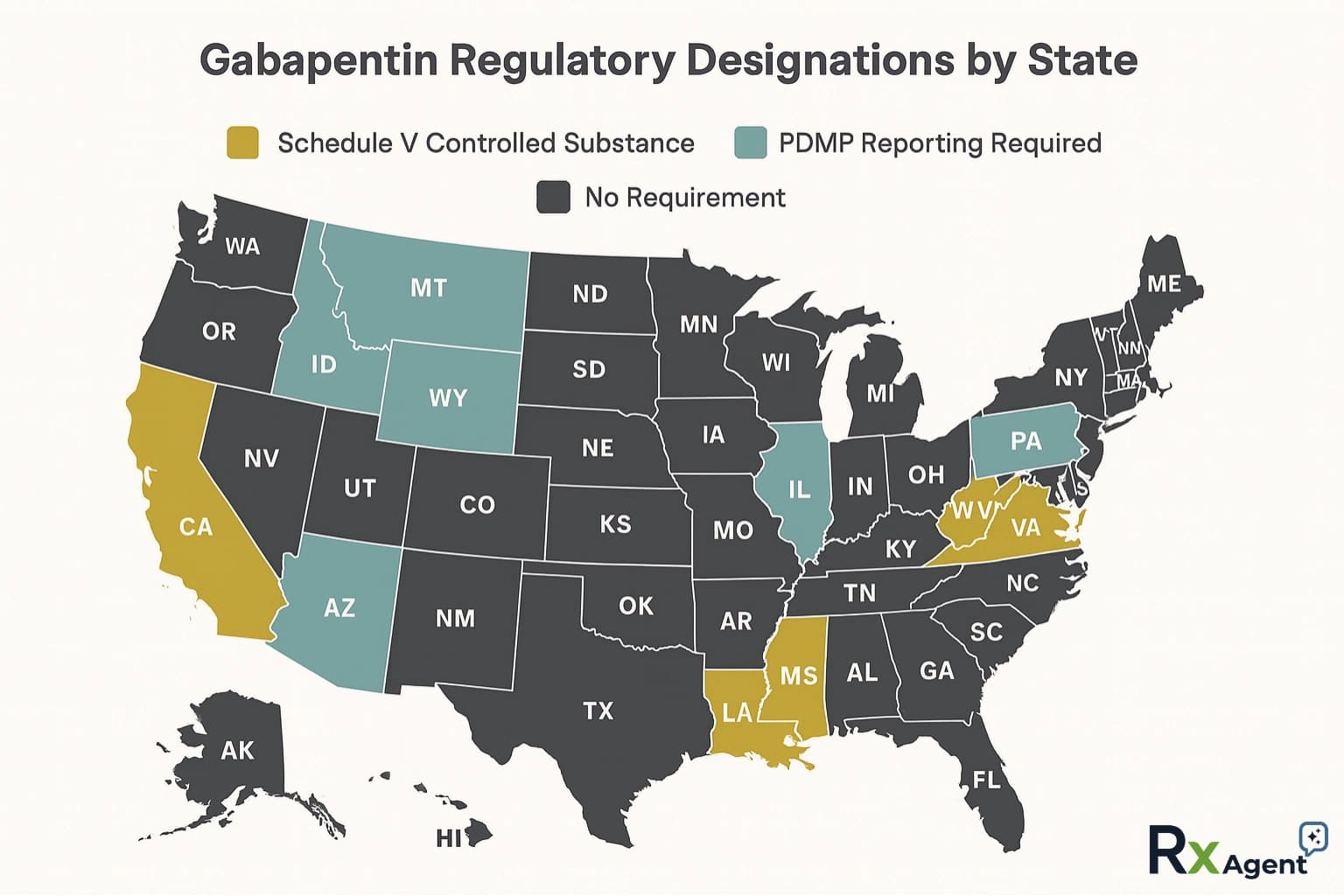
Figure: Current state designations for Schedule V vs PDMP reporting.
A Quick Heads-Up for Clinicians Struggling With All These State Rules
If the map above made you think, “How am I supposed to keep all this straight?” — you’re exactly who Rx Agent is being built for.
In our clinic, tracking gabapentin policy changes used to mean digging through PDFs, state board memos, and outdated pharmacy software. Managing 50 sets of evolving rules has become a full-time job nobody actually has time for.
Rx Agent solves that. It automatically:
- Tracks Schedule V changes in real time
- Updates PDMP reporting requirements
- Flags cross-state prescribing conflicts
I joined the waitlist because I was tired of learning about law changes only after a prescription bounced at the pharmacy.
👉 Get early access here: https://www.rxagent.co/
What Exactly Is Gabapentin?
Gabapentin seems simple, but its mechanism still surprises me.
I explain to patients that gabapentin isn't acting on GABA the way they think. It doesn't bind the usual receptors, and the analgesic pathway is still partially unknown. When we trialed it in our clinic for neuropathic pain back in 2021, response rates were mixed but meaningful enough that we kept it in our toolbox.
How Are Patients Really Using Gabapentin?
Off-label use is more common than FDA-approved use in my experience.
I’ve used it most often for diabetic neuropathy, RLS, anxiety spikes, and chronic sciatica. One patient in 2022 reported better sleep “for the first time in months” after starting a low dose. Others found relief for menopausal hot flashes when SSRIs weren’t tolerated.
Why Are People Misusing Gabapentin?
I didn’t grasp the misuse potential until I saw it paired with opioids.
Back in 2020, I reviewed a chart showing a patient on hydrocodone + gabapentin + clonazepam. The sedation risk was enormous. By 2023, I was seeing misuse rates consistent with published data—15–22% among opioid-using populations and up to 40–65% among certain high-risk groups.
Common combinations I’ve personally seen:
- Opioids
- Alcohol
- Benzos
- Buprenorphine
- Cannabis
These cases usually came with increased falls, blackouts, or ED visits.
What Side Effects Have I Seen in Practice?
Most patients tolerate gabapentin, but the outliers shaped my caution.
The mild side effects—dizziness, swelling, fatigue—show up regularly. But I still remember one 47-year-old patient in 2023 who developed severe withdrawal-based seizures after abruptly stopping 3,600 mg/day. Another experienced angioedema after just two doses. Those cases changed the way I taper and monitor.
Why Did States Start Regulating Gabapentin?
It wasn’t one big event—just a slow, undeniable trend.
Between 2018 and 2023, our clinic increasingly caught diversion cases. In one review, 6 out of 42 high-risk patients had documented gabapentin misuse. States responded accordingly: more scheduling, more PDMP reporting, and more oversight. By 2025, more than half the U.S. had some form of gabapentin-specific regulation.
State-by-State Breakdown
Below is the updated landscape—short, clear, and based on verified state actions.
A. Which States Made Gabapentin Schedule V?
Here’s where gabapentin now legally functions like a controlled substance.
Schedule V + PDMP reporting
- Alabama (AL)
- Kentucky (KY)
- North Dakota (ND)
- Tennessee (TN)
- Virginia (VA)
- West Virginia (WV)
- Utah (UT, added 2024)
- Montana (MT, added 2025)
Michigan (MI)
- Removed from Schedule V on May 28, 2024
- First state to reverse a gabapentin scheduling decision
B. Which States Require PDMP Reporting (But Do NOT Schedule It)?
These states track gabapentin closely without making it a controlled medication.
- Connecticut
- District of Columbia
- Indiana
- Kansas
- Massachusetts
- Minnesota
- Nebraska
- New Jersey
- Ohio
- Oregon
- Wyoming
- Illinois
C. Which States Just Added PDMP Reporting?
- North Carolina (2024) – Pharmacies must report; vets begin reporting 2025
- New Mexico (2023) – Named a “drug of concern,” mandatory reporting
- Wisconsin – Monitored drug; reporting integrated into PDMP
- Oregon (2025) – Expanded PDMP to all Schedule V drugs
D. States Considering Future Regulation
- Maryland
- New York
(Neither has passed new gabapentin rules yet.)
Summary Table
| Category | Meaning | Examples |
|---|---|---|
| Schedule V + PDMP | Controlled substance + mandatory reporting | AL, KY, ND, TN, VA, WV, UT, MT |
| PDMP Only | Not controlled, but monitored | CT, DC, IN, KS, MA, MN, NE, NJ, OH, OR, WY, IL, NC, NM, WI |
| Recent Changes | Added or removed protections | MI (removed), UT & MT (added), NC & NM (PDMP) |
| Considering | Discussion but no law | MD, NY |
Reddit Test: What Clinicians & Patients Say
Whenever I’m unsure how a medication behaves “in the wild,” I check Reddit.
Threads from 2021–2024 show consistent themes: patients reporting intense drowsiness, people mixing gabapentin with alcohol “for a stronger buzz,” and clinicians debating scheduling. One comment with 1.4k upvotes said, “Gabapentin is the new benzo in my county.” That perspective often predicts regulation.
Conclusion
Gabapentin has changed more in five years than many drugs do in twenty.
With new state laws, shifting misuse patterns, and ongoing debate, I’ve learned to treat gabapentin with more respect and more monitoring. Whether you prescribe it daily or rarely, it demands a state-specific, patient-specific approach.
Frequently Asked Questions
About the Author
Dr. Zade Shammout, PharmD writes about prescription medications, pharmacy laws, and healthcare compliance for prescribers and pharmacists.