Nurse Practitioner (NP) Prescribing Authority by State (2026): Controlled Substance Laws
Updated 2026 guide to nurse practitioner prescriptive authority by state, including controlled substances, DEA rules, and telemedicine compliance.
Need the exact rule for your state and role?
Rx Agent returns the cited statute, last-reviewed date, and compliance notes for your state, drug schedule, and prescriber type — in seconds.
Do nurse practitioners write prescriptions?
Yes. Do nurse practitioners write prescriptions in every state? In practice, they can prescribe medications nationwide, but the scope—especially for Schedule II–V controlled substances—varies based on state rules for collaboration, supervision, and any additional state controlled-substance requirements.
Nurse practitioner prescriptive authority by state defines whether an NP may prescribe medications independently or under physician oversight, and whether Schedule II–V controlled substances are permitted. Authority is classified as Full, Reduced, or Restricted, with additional federal DEA requirements governing controlled substance prescribing.
For a comparison of how prescribing autonomy differs between professions, see our guide to Physician Assistant Prescriptive Authority by State.
Which states allow Nurse Practitioners full prescribing authority?
28 states, the District of Columbia, and two territories grant NPs Full Practice Authority (FPA).
This authorizes NPs to evaluate patients, diagnose, and prescribe medications (including Schedule II-V controlled substances) under the exclusive licensure of the state board of nursing, without physician oversight.
In FPA states, the NP is the captain of the ship, holding independent prescriptive authority. Licensure is not contingent on what the AANP describes as "unnecessary contracts or relationships with a physician" [1]. This model is currently the standard in the entire Pacific Northwest and much of the Southwest [2].
However, "Full Practice" often comes with caveats. For example, California is in a multi-year transition. NPs are classified as "103 NPs" (working in facilities) or "104 NPs" (independent) [3]. Full independence requires 4,600 hours or three years of clinical experience before the "leash" is fully cut [3]. Similarly, Virginia requires five years of clinical experience before an NP can practice without a patient care team physician [3].
Conversely, in Restricted Practice states like Georgia and South Carolina, NPs are severely limited. In Georgia, NPs are prohibited from prescribing Schedule II drugs entirely [3]. In South Carolina, NPs are restricted from Schedule II prescribing except for very limited supplies (5-day limit for narcotics), despite pending legislation to expand this scope [3].
NP Prescribing Authority by State Map (2026)
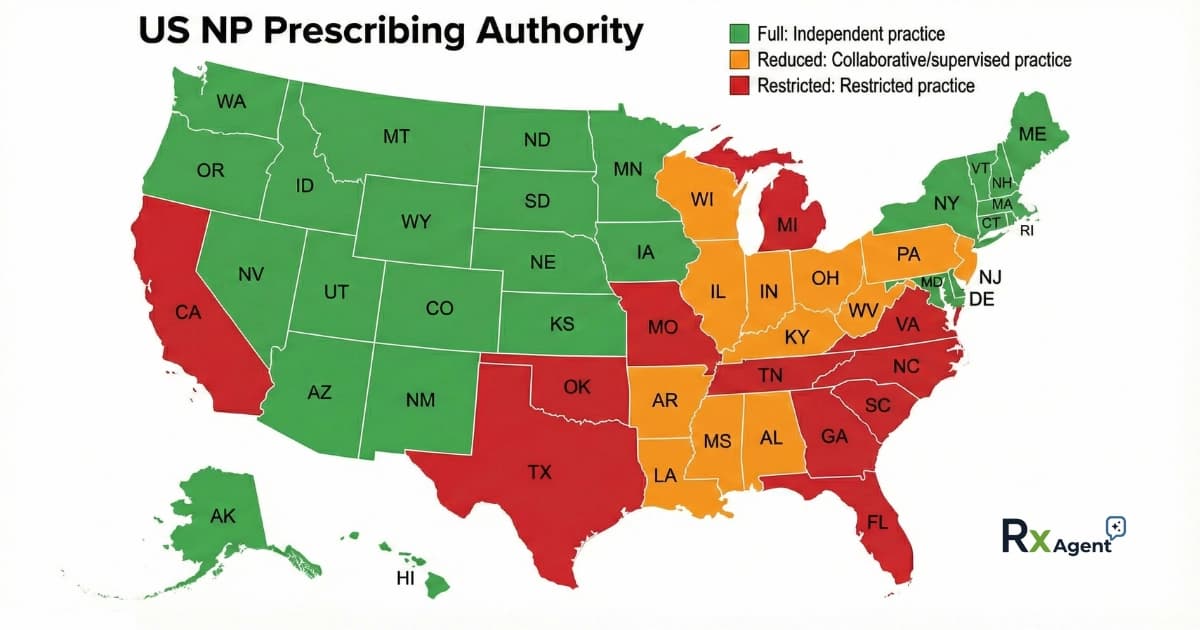
Figure: State-by-state breakdown of Nurse Practitioner prescribing authority, showing Full Practice Authority (FPA), Reduced, and Restricted practice environments.
Nurse Practitioners Prescribing Authority Table (2026)
The following table synthesizes data regarding nurse practitioner prescribing laws by state, specifically focusing on their ability to prescribe controlled substances (CS).
- FPA: Full Practice Authority (Independent)
- Reduced: Collaborative agreement required
- Restricted: Supervision required
- Sch II: Schedule II Controlled Substances
| State | NP Authority | Key Prescribing Notes |
|---|---|---|
| AL | Reduced | NP: Sch III-V only. Sch II prohibited [3]. |
| AK | Full | NP: Independent [3]. |
| AZ | Full | NP: Independent [3]. |
| AR | Reduced | NP: Collaborative agreement required [3]. |
| CA | Restricted* | *NP: Transitioning to FPA (103/104 status). Sch II requires course [3]. |
| CO | Full | NP: Independent [3]. |
| CT | Full | NP: Independent after 3 years [3]. |
| DE | Full | NP: Independent upon licensure [3]. |
| FL | Restricted | Florida nurse practitioner prescribing laws limit Sch II to 7-day supply [3]. |
| GA | Restricted | Restriction: NP prohibited from prescribing Sch II [3]. |
| HI | Full | NP: Independent [3]. |
| ID | Full | NP: Independent [3]. |
| IL | Reduced | NP: Full practice eligible after 4,000 clinical hours [3]. |
| IN | Reduced | NP: Sch II-V requires agreement. No weight loss Sch IIs [3]. |
| IA | Full | NP: Independent [3]. |
| KS | Full | NP: Independent [3]. |
| KY | Reduced | NP: Sch II-V requires CAPA-CS agreement [3]. |
| LA | Reduced | NP: Sch II prohibited for obesity/chronic pain [3]. |
| ME | Full | NP: Independent after 24 months [3]. |
| MD | Full | NP: Independent after 18-month mentorship [3]. |
| MA | Full | NP: Independent after 2 years [3]. |
| MI | Restricted | NP: Requires delegation [3]. |
| MN | Full | NP: Independent after 2,080 hours [3]. |
| MS | Reduced | NP: Sch II requires QA program/chart review [3]. |
| MO | Restricted | NP: Restricted practice environment; delegation/supervision required [3]. |
| MT | Full | NP: Independent [3]. |
| NE | Full | NP: Independent after 2,000 hours [3]. |
| NV | Full | NP: Sch II requires 2,000 hours/protocol [3]. |
| NH | Full | NP: Independent [3]. |
| NJ | Reduced | NP: Joint protocol required [3]. |
| NM | Full | NP: Independent [3]. |
| NY | Full | NP: Independent after 3,600 hours [3]. |
| NC | Restricted | NP: Sch II/III limited to 30-day supply [3]. |
| ND | Full | Standout: NP practices independently [3]. |
| OH | Reduced | NP: Sch II restrictions (e.g., terminal illness, MD initiation) [3]. |
| OK | Restricted | Restriction: NP excluded from independent Sch II [3]. |
| OR | Full | NP: Independent [3]. |
| PA | Reduced | NP: Sch II limited to 72hr (initial) or 30-day (ongoing) [3]. |
| RI | Full | NP: Independent [3]. |
| SC | Restricted | Restriction: NP Sch II limited (5-day narcotic/30-day non) [3], [4]. |
| SD | Full | NP: Independent after 1,040 hours [3]. |
| TN | Restricted | NP: Sch II/III limited to 30-day supply [3]. |
| TX | Restricted | Texas nurse practitioner prescribing laws: Sch II limited to hospital/hospice settings [3]. |
| UT | Full | NP: Independent [3]. |
| VT | Full | NP: Independent after 24 months [3]. |
| VA | Restricted | NP: Becomes independent after 5 years of clinical experience (transitions to autonomous practice after the experience requirement) [3]. |
| WA | Full | NP: Independent [3]. |
| WV | Reduced | NP: Sch II limited to 3-day supply [3]. |
| WI | Reduced | NP: Sch II-V authorized [3]. |
| WY | Full | NP: Independent [3]. |
Federal Shift: The DEA Telemedicine Special Registration
Proposed DEA rules create a "Special Registration" for telemedicine prescribing.
This allows practitioners to prescribe Schedule II-V drugs without an in-person visit if they hold this registration, conduct a nationwide PDMP check, and verify patient identity via audio-video technology.
State law is only half the battle; federal law is the other. Under the Ryan Haight Act, an in-person medical evaluation is required before prescribing controlled substances [3]. The COVID-19 Public Health Emergency (PHE) waived this, but those waivers expire at the end of 2025 [3].
To solve this, the DEA released a proposed rule in January 2025 establishing a Telemedicine Special Registration [3].
Nurse practitioner DEA license requirements (and the DEA application)
State authority governs whether you may prescribe, but DEA registration governs what controlled substances you may prescribe federally. In general, NPs should confirm: (1) state prescriptive authority, (2) any state controlled-substance registration, and (3) the appropriate DEA registration before prescribing Schedule II–V medications. (Educational overview only—verify your state’s rules.)
Can a nurse practitioner prescribe Adderall via telemedicine?
Can a nurse practitioner prescribe Adderall (Schedule II) via telemedicine? Potentially—but it depends on (1) whether the patient’s state grants Schedule II authority to NPs, and (2) whether federal rules allow the telemedicine pathway you’re using (e.g., the proposed DEA Special Registration framework and related identity/PDMP requirements).
- The Workflow: If you are an NP in a "Full Practice" state, you still need this federal Special Registration to prescribe Adderall (Schedule II) or Testosterone (Schedule III) via Zoom without seeing the patient in person first [3].
- The Catch: You must hold a DEA registration in every single state where your patients are located [3].
- The Buprenorphine Exception: A separate final rule allows for the induction of Buprenorphine (for Opioid Use Disorder) via audio-only telemedicine without the Special Registration, expanding access significantly [3].
The Expanding Scope of NP Autonomy
In my analysis of legislative trends, the legal architecture governing nurse practitioner prescribing authority is undergoing a tectonic shift.
In practical terms, nurse practitioners can prescribe medication nationwide, but controlled substance prescribing depends on each state’s nurse practitioner prescriptive authority (full, reduced, or restricted).
We are moving away from a physician-centric monopoly toward a decentralized model where Mid-Level Practitioners (MLPs)—specifically Nurse Practitioners (NPs)—hold significant autonomy. Many patients and policy-makers frequently ask, "Can nurse practitioners prescribe medication independently?" The answer depends entirely on geography.
Whether through the adoption of the APRN Compact in states like Utah and Delaware, the tether between NPs and physicians is loosening [7]. However, this freedom comes with increased administrative liability—specifically regarding PDMP checks and the new DEA Special Registration for telemedicine.
If you are a practitioner operating across state lines, you cannot rely on a single license. You must cross-reference your "home" state’s authority with the "patient’s" state laws and federal DEA overlays [7].
References
1. https://www.aanp.org/advocacy/advocacy-resource/policy-briefs/issues-full-practice-brief
2. https://nurse.org/education/np-full-practice-authority/
3. https://www.tebra.com/theintake/checklists-and-guides/legal-and-compliance/nurse-practitioner-laws-by-state
4. https://www.scstatehouse.gov/billsearch.php?billnumbers=3580
5. https://nacns.org/wp-content/uploads/2020/08/PractPrescAuthority7.31.2020.pdf
6. https://www.dlapiper.com/insights/publications/2025/01/dea-and-hhs-publish-rules-for-telemedicine-prescriptions
7. https://www.govinfo.gov/content/pkg/FR-2025-01-17/pdf/2025-01099.pdf
Frequently Asked Questions
About the Author
Dr. Zade Shammout, PharmD writes about prescription medications, pharmacy laws, and healthcare compliance for prescribers and pharmacists.